 Lastinger Learning
 New Worlds Reading
 Florida Tutoring Advantage
2023 Math Listening Tour – Brief 6
A Need for Strengthening Mathematics Instruction Through HQIM-Aligned Professional Learning and Infrastructure
In the Fall of 2023 we conducted a Listening Tour across the state of Florida in an effort to understand the current state of mathematics education. This brief reports on what we learned from business and community leaders, teachers, students, and other stakeholders about the need for HQIM-aligned supports for mathematics instruction.
Key Insight
Employers Need Employees With Mathematical Thinking and Reasoning Skills
Florida’s economy depends on a workforce with strong mathematical reasoning and problem-solving skills. Yet, findings from the UF Lastinger Center’s 2023 Listening Tour reveal a disconnect between what employers need and what students experience in mathematics classrooms. Business and community leaders, teachers, students, and other stakeholders agree that to prepare graduates for college, careers, and civic life, Florida must invest in high-quality instructional materials (HQIM) and professional learning (PL) aligned with the Florida B.E.S.T. Standards, particularly the Mathematical Thinking and Reasoning Standards (MTRs; FLDOE, 2020). This brief outlines the evidence and recommendations for building an infrastructure that supports HQIM-aligned PL statewide. For a comprehensive report of the Listening Tour and our methodology, visit bit.ly/LCListeningTour.
In the Listening Tour, business and community leaders across Florida (N = 92) emphasized that graduates need more than just procedural math skills to be effective and efficient at their job, or to increase their future career opportunities. Graduates need to reason, solve problems collaboratively, and explain their thinking clearly. This finding is echoed by the Florida Chamber Foundation’s (2024) analysis of skills included in job ads across Florida. Moreover, the Florida Chamber Foundation (2021) reported 900,000 unfilled jobs in mathematics-intensive fields such as health care, business, and finance, signaling a growing demand for a mathematically skilled workforce.


Decades of research confirm that access to HQIM, coupled with curriculum-aligned PL, is essential for developing the reasoning, problem-solving, and communication skills employers demand (National Council of Teachers of Mathematics [NCTM], 2018; Alicea et al., 2025; Steiner et al., 2025). These findings underscore that instructional quality beyond general content coverage drives the workforce readiness outcomes highlighted by Florida business leaders. Nonetheless, despite the increased attention on these in-demand skills, such as the Mathematical Education of Teachers II report (CBMS, 2012), and the Florida B.E.S.T. MTRs, which have been in effect for the last five years (FLDOE, 2020), teacher education and school systems have struggled to implement effective changes that could benefit students and support workforce needs. Exacerbating these challenges is the current shortage of certified mathematics teachers in Florida: in 2023–24, 4,028 math courses were taught by teachers without appropriate certification (FLDOE, 2025). These challenges were visible in teachers’ survey responses, where they frequently reported having students listen to them explain and practice procedures, which is precisely a skill most employers do not value.
They should be able to critically think and use some order of progression, which probably is algebra, but they need to be prepared for that. Because if somebody can critically think and if they can apply logic, they can learn anything.
North Central Florida Business Leader
I don’t care if you’ve got the right answer if you can’t tell me how you’ve got the right answer because I’m trying to understand how you think… I just need to understand that you have a thought process.
North Central Florida Business Leader
Education Stakeholders Want High-Quality Professional Learning Aligned With High-Quality Instructional Materials
Despite the disconnect between mathematics classroom experiences and workforce needs, a common theme across 84 focus groups with 284 education stakeholders was a strong desire for change. Participants shared the vision that investing in high-quality PL and HQIM is essential to develop strong conceptual understanding, which supports college and career readiness, as well as global citizenship. Teachers have a perception that current PL models are not meeting their needs and expressed a desire for hands-on activities, manipulatives, and classroom discussion that foster more mathematics discourse in the classroom. Survey data revealed widespread demand for PL focused on addressing misconceptions, implementing engaging tasks, and monitoring understanding. From these data sources, it was clear that teachers shared a deep desire to implement the MTRs and foster a more engaging mathematics classroom learning environment where development of the skills promoted in the MTRs may flourish.

Students echoed these sentiments as they often seek learning opportunities that prioritize collaboration and meaningful exploration with mathematical concepts. Among 384 elementary students and 194 secondary students, many described wanting math classrooms that are interactive, collaborative, and focused on understanding rather than memorization:
We all like problem-solving, but the way that some teachers teach it, they just don’t make it into a problem-solving thing. They just turn it into a really monotone lecture.
Tampa Area High School Student
While teachers and other stakeholders energetically shared their desires for a different learning environment, they identified barriers to their success in those efforts. The barrier most frequently mentioned during interviews was the lack of time for planning and PL. For example, 54% (of 659) teachers in our survey revealed that they have no more than 3 hours per month to dedicate to PL.
Echoing this barrier, some teachers addressed practical solutions, such as leveraging early-release days and flexible options:
“In our district, we have half days, early release days scheduled into our calendar. I think incorporating time during those early release days to participate in professional development that is really relevant, not necessarily required or mandated, would be very helpful. I also think that maybe an online component where you have more flexibility to do it at your own pace would be helpful.”
Elementary Teacher, Southeast Florida
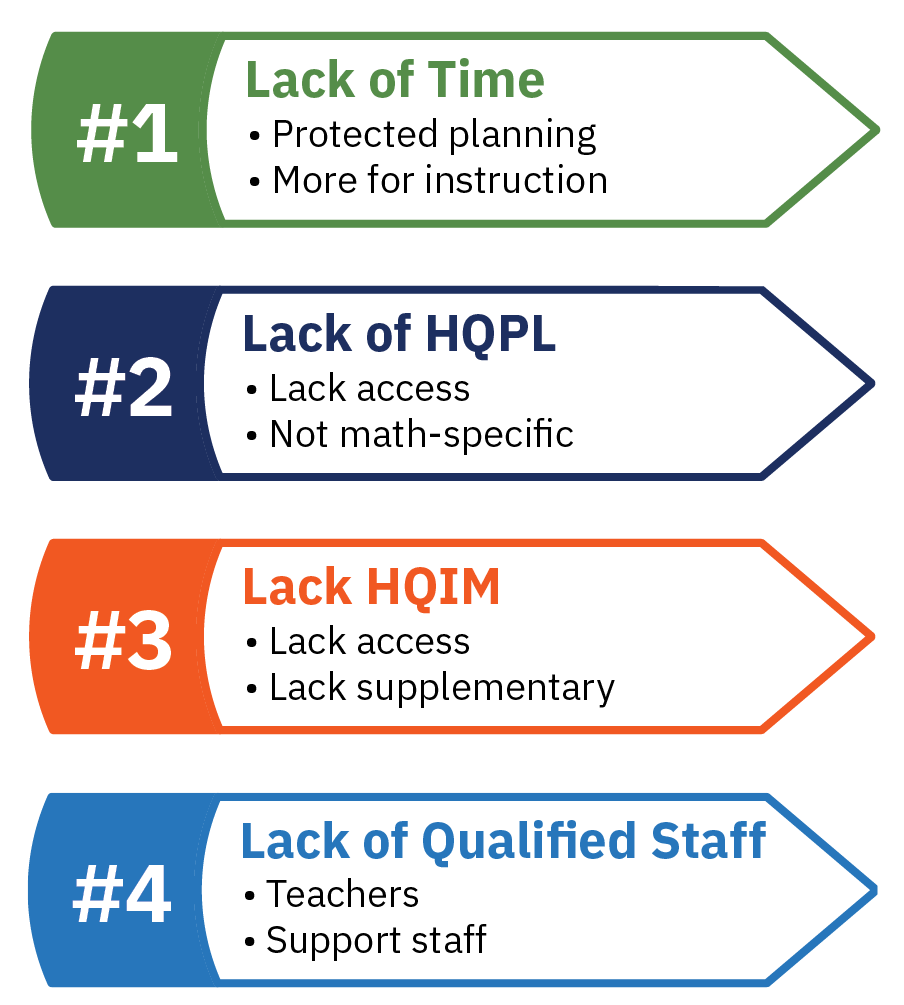

Additional barriers included insufficient HQIM and high-quality PL; and difficulty recruiting and retaining qualified, highly-effective teachers, especially at the high school level:
We’re struggling in the middle and high schools to really find true algebra teachers, geometry teachers, and those high—you know, I have a school where I have just one AP Calculus teacher.
Southeast Florida District Leader
To translate this shared vision into action, Florida needs a comprehensive infrastructure that positions HQIM-aligned PL, leadership support, and coaching as levers for improving classroom instruction and workforce readiness.
Recommendation
Build Infrastructure to Support HQIM-Aligned Professional Learning
Invest in Research to Guide HQIM-Aligned PL Implementation.
Findings from the Research Partnership for Professional Learning (RPPL; Alicea et al., 2025) and the RAND Corporation (Steiner et al., 2025) show that PL aligned with HQIM improves teacher practice and student outcomes. (Alicea et al., 2025; Steiner et al., 2025). Yet, critical questions remain:
- How are PL offerings selected at district and school levels?
- To what extent is HQIM-aligned PL implemented statewide?
- What outcome data are currently being collected to evaluate impact?
Investing in research should be a priority to address these questions and ensure future PL investments are evidence-based, accessible, and aligned with the instructional shifts needed to realize the vision of the MTRs.

Scale Innovative HQIM-Aligned PL Models Statewide.
The Lastinger Center has already taken significant steps to address the need for HQIM-aligned PL through the launch of the Math Matrix Micro-Credential. This flexible, asynchronous, competency-based PL system supports educators in deepening their mathematics content knowledge and instructional practice through job-embedded learning experiences. As Florida prepares for a new mathematics curriculum adoption cycle, expanding access to models like the Math Matrix will be critical for ensuring teachers are supported through implementation.

Conclusion
High-quality instructional materials and professional learning are essential for transforming mathematics education in Florida. The Listening Tour revealed a shared vision for MTR-aligned instruction, but realizing that vision requires investment in the infrastructure that supports teachers. By scaling HQIM-aligned PL and addressing systemic barriers, Florida can ensure that every student experiences mathematics as meaningful, engaging, and empowering, preparing them for college, careers, and civic life.
References
Alicea, S., Davis, C., Foster, E., Hornak, R., Hyler, M., Morrison, A., Papay, J., Richardson, J., Schwartz, N., & Wechsler, M. (2025). Defining curriculum-based professional learning: Building a common language (p. 26). Research Partnership for Professional Learning.
Conference Board of the Mathematical Sciences. (2012). The mathematical education of teachers II. Issues in Mathematics Education, 17. American Mathematical Society.
Florida Chamber Foundation. (2021). Florida workforce needs study.
Florida Chamber Foundation. (2024). Florida workforce needs study 2.0.
Florida Department of Education [FLDOE]. (2020). Florida K-12 mathematical thinking and reasoning standards. Florida’s B.E.S.T. Standards: Mathematics.
Florida Department of Education [FLDOE]. (2025). Identification of high demand teacher needs areas for 2025-26.
National Council of Teachers of Mathematics. (2018). Catalyzing change in high school mathematics: Initiating critical conversations. NCTM.
Steiner, E. D., Covelli, L., Tekkumru-Kisa, M., & Diliberti, M. K. (2025). Prioritizing curriculum-based professional learning for mathematics teachers: District, principal, and teacher perspectives from the american educator panels. RAND Corporation.