 Lastinger Learning
 New Worlds Reading
 Florida Tutoring Advantage
2023 Math Listening Tour – Brief 1
Students’ Experiences in the Mathematics Classroom
In the Fall of 2023 we conducted a Listening Tour across the state of Florida in an effort to understand the current state of mathematics education. This brief reports on what we learned from and about students and their experiences with mathematics.
Key Insight
Students Want the Math Thinking and Reasoning Standards More Integrated Into Their Learning Experiences
The Florida B.E.S.T. Mathematical Thinking and Reasoning Standards (MTRs; FLDOE, 2020) describe the ways in which students should engage in mathematics with a goal of deep learning and understanding.
Among them are a focus on:
- collaborative and active learning encompassed within an environment that supports students to persevere through struggle (MTR.1.1),
- collaborative discussions to critique, argue, question, and reflect on one another’s thinking (MTR.4.1, MTR.6.1),
- flexibly using multiple representations (e.g., numbers, pictures, graphs) and procedures (formulas and steps to follow to solve math problems) to draw connections between concepts to build deep understanding (MTR.2.1, MTR.3.1, MTR.5.1) and
- applying mathematics to students’ everyday experiences (MTR.7.1).
Students, teachers, and business professionals all shared visions of mathematics instruction and classrooms that embodied the MTRs; however, stakeholders’ visions of what mathematics instruction could be were often far removed from what students experience on a daily basis.
Whenever we just lecture and go over it, I feel like it comes in one ear and out the other.
Western Panhandle High School Student
The Student Experience
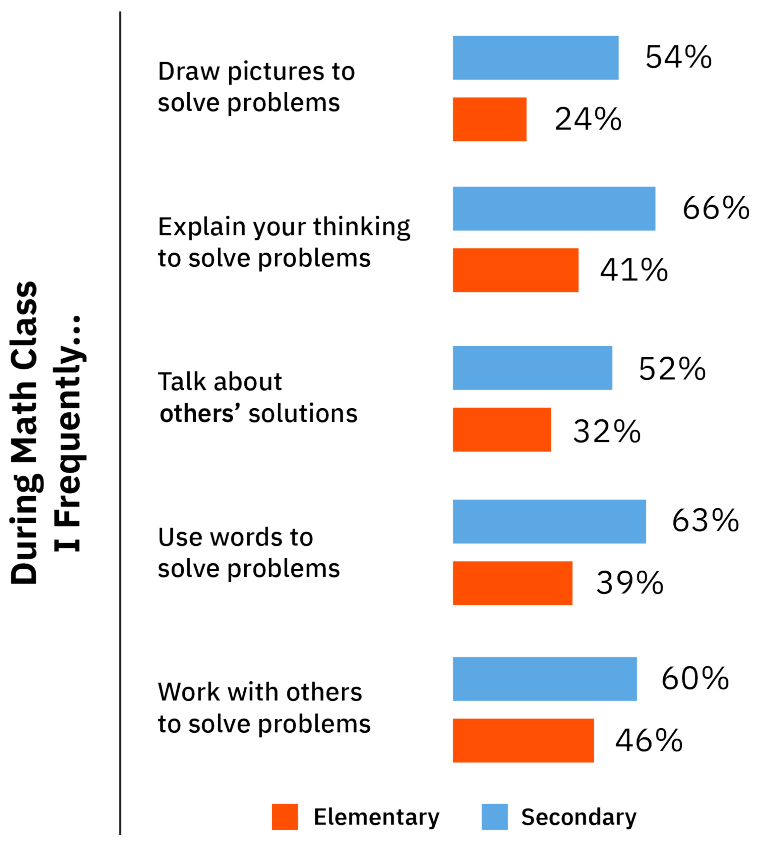
In interviews with 65 students and survey responses from 1,879 students across Florida, students across all grade levels frequently described their current mathematics class experiences as largely passive.
Frequent activities included the teacher explaining how to solve problems, students copying procedures into their notes, and learning the steps through repetitive practice.
Moreover, when asked about how often they experienced classroom activities aligned with the MTRs on the survey, although one-half to two-thirds of elementary students reported experiencing them at least most days, by secondary grade levels, proportions dropped substantially to between 46% and 24%.
A majority of surveyed adults shared similar experiences about their K-12 mathematics journey, with those who experienced only direct instruction across K–12 being substantially more likely to report that this type of instruction was not very effective.
Teachers’ Perspective
Contrasting with these experiences, teachers reported on the survey that they frequently support students to learn from mistakes (80%) and ask students to explain how they solve problems (78%); however, the way students are receiving such instruction does not align with teachers’ intent.
Further contrasting with teacher reporting, four of the top five most frequent activities math coaches reported seeing when observing teachers were students working individually (68%), students practicing procedures (63%), having students memorize facts and procedures (53%) and having students listen to the teacher lecture (53%).
School administrators reported frequently observing these activities as well. All stakeholder groups, including teachers, expressed that they want students to know mathematics deeply and learn mathematics in robust ways. Yet, there is a disconnect between how teachers currently teach and how students hope to learn as they strive to achieve the K-12 mathematics vision outlined in the MTRs.
We all like problem-solving, but the way that some teachers teach it, they just don’t make it into a problem-solving thing. They just turn it into a really monotone lecture.
Tampa Area High School Student
I feel like making it fun to learn because like if it’s fun, then people are going to be interested and want to learn the subject.
Central Florida High School Student
What Students Want
When asked what students would change about math class or what they wished for, students asked for opportunities to more actively engage with the mathematics content, collaborate with others, and for their mathematics experience to be fun.
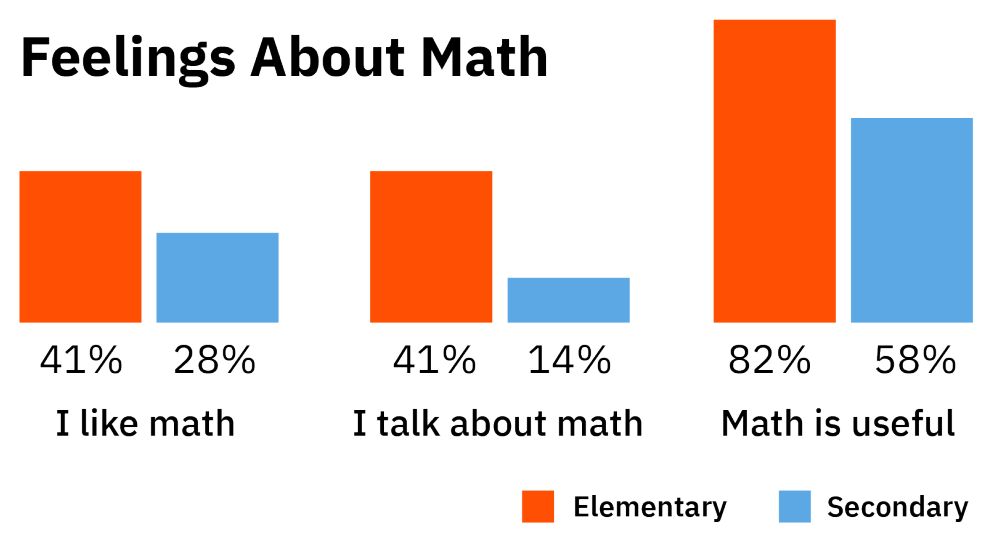
Student requests for enhancing their math class experience may be one way to counteract their declining views on mathematics as they move from elementary to secondary schools. Although we can’t know for certain based on our data why secondary students enjoy math less and also find it less useful than elementary students, one possible reason is the association between declining sentiment towards math and the decreased use of instructional strategies students find engaging.
The type of math class students desire is not easy to attain if the focus of school math is solely procedures. Students want math to be engaging, interactive, and fun which means they need opportunities to solve mathematically-rich problems in collaboration with their peers and allow for students to discuss the varied ways in which they found their solution. Doing so allows students to build their confidence and develop a greater depth of understanding, both conceptually and procedurally.
Recommendation
Improve Student Learning Experiences Through Targeted Teacher Professional Learning
Across focus group interviews and survey responses, current student mathematics class experiences appear to have little overlap with the types of activities teachers reported they frequently have their students engage in, and are further at odds with what students aspire for in their mathematics class.
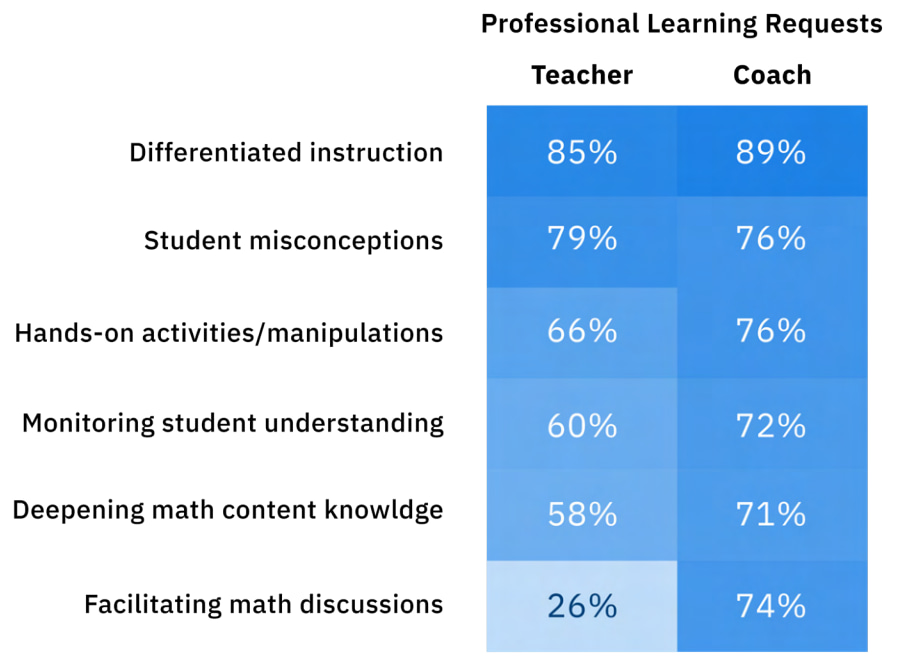
However, when teachers were asked what kinds of professional learning they want, it was much more aligned with what students would like to experience, and what math coaches reported was most in need for teachers in the schools they worked with.
There were a few specific areas that are more likely to produce the positive changes that all stakeholders are pointing toward, as outlined below.
Engage Students in Collaborative Learning Activities
Students expressed desire for less lecture and procedural practice, and more interaction with their peers to collaboratively solve problems. Teachers and math coaches alike expressed a need for professional learning on implementing hands-on activities, while math coaches further reported a top need for professional learning on facilitating math discussions. Finally, business professionals widely reported that being able to collaborate with others to solve problems was a vital skill for postsecondary success.
It is clear that professional learning on creating an active, collaborative mathematics classroom learning environment is a top need across the state. There is clear research evidence from national and international studies that when such a learning environment is fostered, it leads to higher academic achievement, motivation and self-efficacy (Ekmekci & Serrano, 2022; Kitsantas et al., 2021; Mullis et al., 2019; OECD, 2014; 2020; 2024).

Engage Students in Meaningful Math Experiences
Students frequently commented in focus groups that they wanted to more deeply understand the math they were learning. Meaningful mathematical experiences emphasize the of mathematics. Such experiences are necessary for students to see mathematics as useful and enjoyable. However, teachers need support to deepen their knowledge of the content they teach and how students learn it.
They also need support in developing their instructional practice to draw on that content knowledge to support students in developing a robust understanding of mathematics through the active and collaborative learning environment that students, teachers, coaches and other stakeholders have envisioned. Strong research evidence suggests that when students consistently have mathematics teachers with deep content and instructional practice expertise, it leads to significantly higher likelihood of educational attainment (Lee & Lee, 2020).
These recommendations for mathematics professional learning are reflective of the mathematics education envisioned by teachers, administrators, instructional coaches and business professionals from across Florida. Research supports these efforts as promising for actualizing the shared vision of a mathematics education that promotes mathematics as enjoyable, relevant, useful, accessible and understandable.

References
Ekmekci, A., & Serrano, D. M. (2022). The impact of teacher quality on student motivation, achievement, and persistence in science and mathematics. Education Sciences, 12(10), 649.
Florida Department of Education [FLDOE]. (2020). Florida K-12 mathematical thinking and reasoning standards. Florida’s B.E.S.T. Standards: Mathematics.
Kitsantas, A., Cleary, T. J., Whitehead, A., & Cheema, J. (2021). Relations among classroom context, student motivation, and mathematics literacy: A social cognitive perspective. Metacognition and Learning, 16(2), 255–273.
Lee, S. W., & Lee, E. A. (2020). Teacher qualification matters: The association between cumulative teacher qualification and students’ educational attainment. International Journal of Educational Development, 77, 1–10.
Mullis, I. V. S., Martin, M. O., Foy, P., Kelly, D. L., & Fishbein, B. (2020). TIMSS 2019 International Results in Mathematics and Science.
OECD. (2014). PISA 2012 results: What students know and can do—Student performance in
mathematics, reading and science (Volume I, Revised edition, February 2014).
OECD. (2020). Global teaching insights: A video study of teaching. OECD Publishing.
OECD. (2024). PISA 2022 results (Volume III): Creative minds, creative schools. OECD Publishing.